The call came on a Friday. The yard needed a 50A marine isolation transformer. They already knew the rating. One 50A, 120/240V shore inlet. 12 kVA. Isolation, not a galvanic isolator.
They did not know where to put it, and they did not want to wait a month to find out.
The marina pedestal opened every time they plugged in. A new dock rule was coming that treated a galvanic isolator as not enough. The only open volume on the boat was a small unused cabinet low in the hull. Plywood. Two rough shelves. Almost no airflow. A conventional 50A marine isolation transformer, the 170 to 235 pound steel box, was not going to live there.
We quoted a Dual MP6 that afternoon. It shipped the following Monday. That is the job a Dual MP6 installation is built for. Same 12 kVA. Two pucks instead of one can. Days, not a production slot.
What they needed, and what was in the way
The spec was clear before the first photo arrived.
| They needed | Why |
|---|---|
| 50A marine isolation transformer | One 50A, 120/240V inlet. 50A × 240V = 12 kVA |
| True isolation | Galvanic isolator was not stopping corrosion or satisfying the marina |
| A unit that could land in a small cabinet | The only space had two shelves and almost no airflow |
| Something that would not trip the pedestal | 30 mA ELCI was opening on hookup |
| A ship date that matched the haul | Friday call, Monday truck |
Galvanic corrosion was the one they could see. Shore ground was tying the hull to the dock and to the boats on either side. Zincs were sacrificing themselves. Shafts and running gear were next. A galvanic isolator only blocks low-voltage DC on the green wire. It does not isolate the boat. AC leakage and a bad dock ground still have a path. They needed a transformer.
ELCI trips were the one they felt every Friday. The pedestal would open on hookup. A 30 mA shore device is doing what the code asked it to do. A healthy boat can still leak enough to trip it, and a cold 12 kVA core without soft start makes the first close worse. The crew was resetting the dock before they could run air conditioning.
Marina rules were the one they could not talk their way out of. More yards now want a 50A marine isolation transformer on the inlet before they will leave the cord energized.
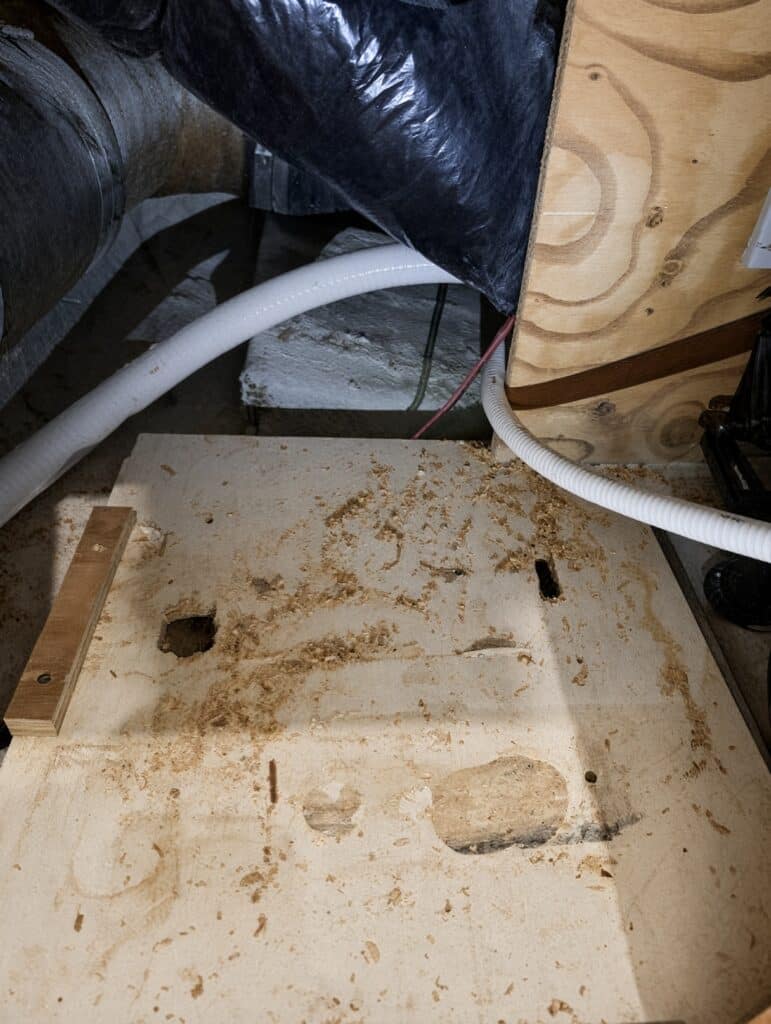
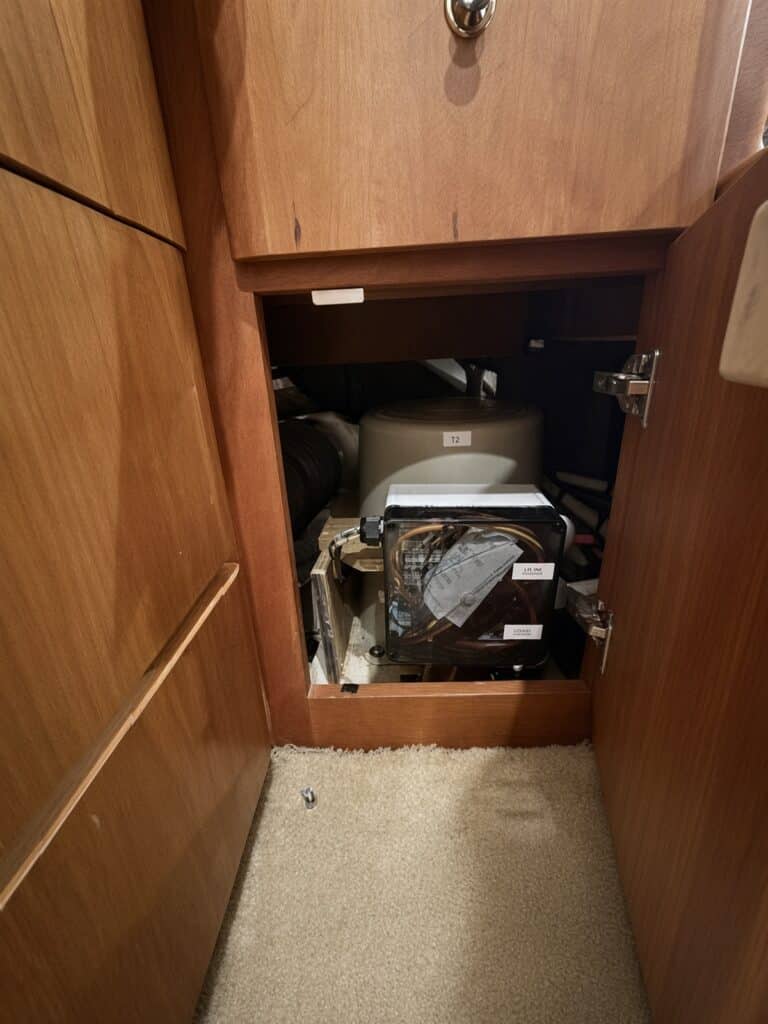
They sent a photo of the cabinet on that Friday call. Empty. Low. The door barely cleared the upper shelf. That photo decided which 50A marine isolation transformer could actually go on the boat. The Monday ship is why it went on this haul instead of the next one.
Why a normal 50A box was out
Charles used to sell this rating as one metal cabinet, about 235 pounds, roughly 18 by 15 by 12 inches. Hubbell’s 50A unit is a 15 kVA steel or stainless box, about 170 pounds. Both want clearance so the core can dump heat.
This boat did not have clearance. It had two shelves and still air.
Putting a laminated 50A marine isolation transformer in that cabinet would have solved the nameplate and failed the boat. Heat with nowhere to go. A door that would not close. A hoist into a space that was never a machinery space. And a lead time that would have missed the window they called about on Friday.
What we quoted
One Dual MP6. Two MarinePuck MP6 units. That is the 50A marine isolation transformer for this inlet. 12 kVA. 120/240V. Out the door Monday.
Each puck is 12.6 inches across and 6.5 inches high. About 80 pounds. Together, 160 pounds, split into two lifts. Soft start on both. 104V and 208V boost taps on both. Hermetically sealed in flame-rated ABS. No case to ground.
| Their constraint | Dual MP6 |
|---|---|
| 50A, 240V shore | 12 kVA, two 6 kVA pucks |
| Cabinet too small for one box | One puck per shelf |
| No airflow | Toroidal core, high 90s efficiency |
| Pedestal trips on plug-in | Soft start |
| East Coast, South, Caribbean docks | Boost taps or straight 240V |
| Wet locker | Epoxy-sealed ABS, Class II |
| Friday call | Shipped Monday |
One puck would have been the wrong quote. One MP6 is 6 kVA. This 50A, 240V inlet needed both.
How the install went
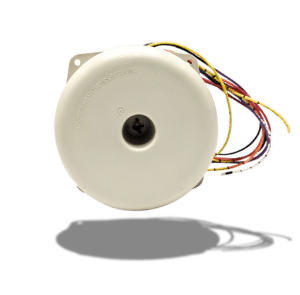
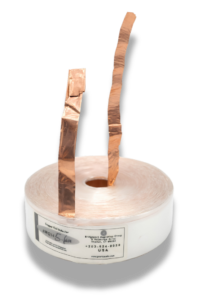
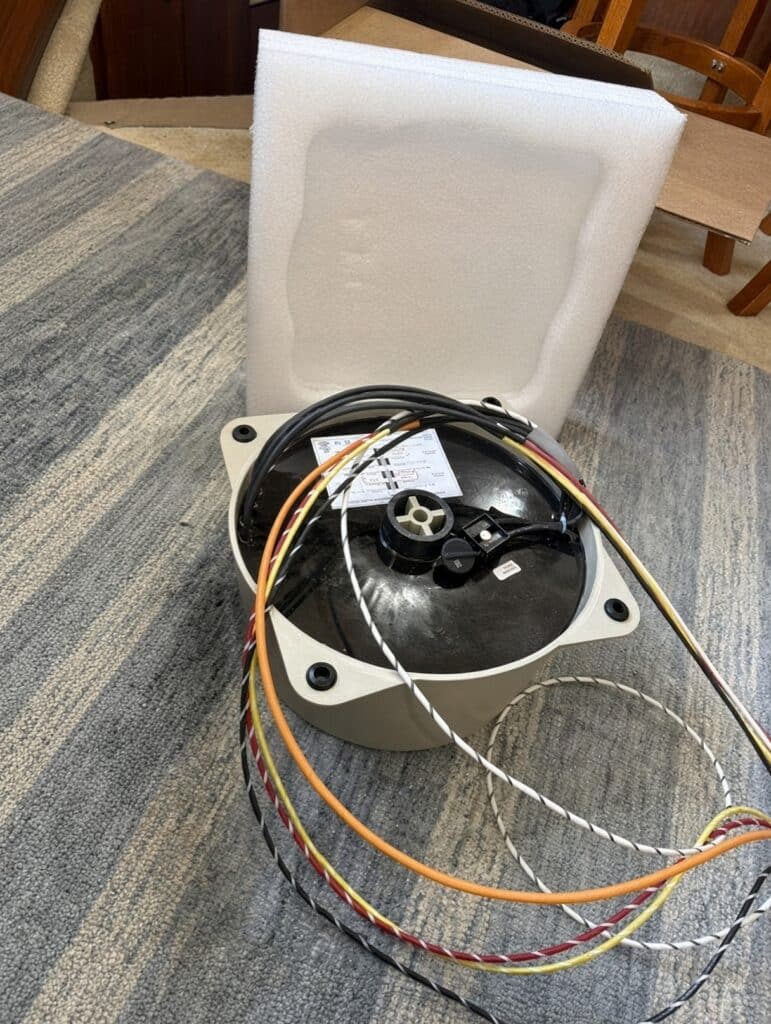
The second photo is an MP6 on the bench, the unit that left Shelton on Monday. Leads out. Sealed body. Nothing about it looks like the steel cabinet they could not fit, because it was not that cabinet. It was half of the 50A marine isolation transformer.
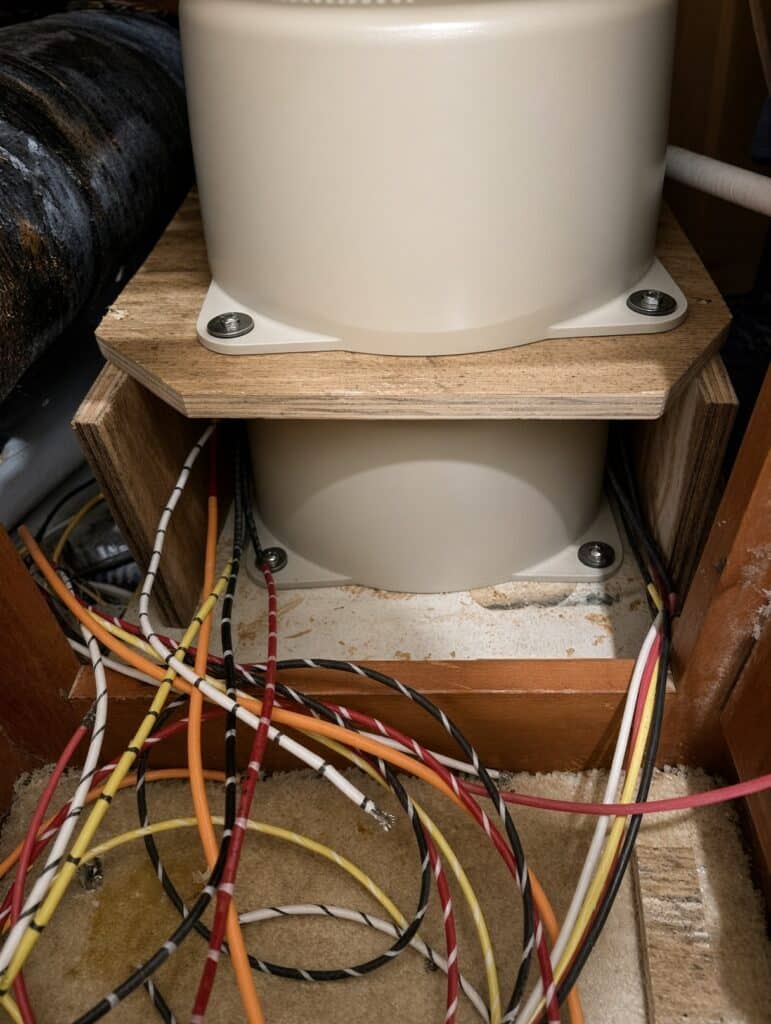
The third photo is the fit. Lower shelf, one puck. Upper shelf, the second. Stacked in the only volume the boat had. The door still shut. That stack is the whole 12 kVA system.
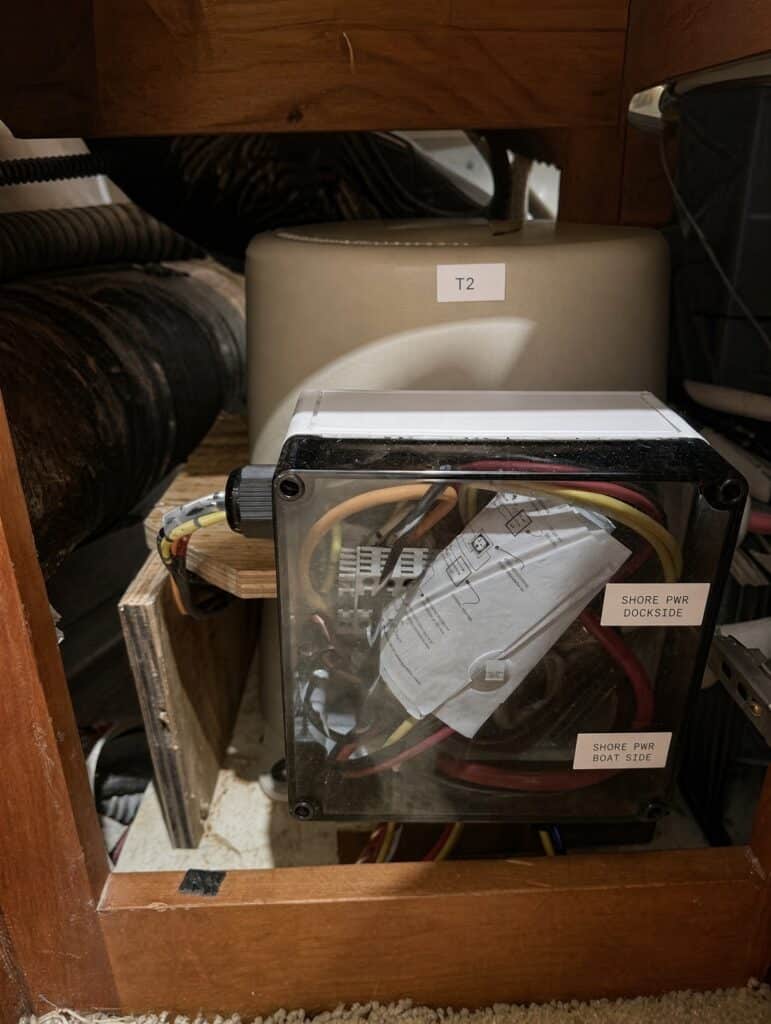
The last two photos are the part that makes a tight install safe. Every lead landed in a junction box. No open splice in the bilge. Labels on the conductors. The cabinet went back to looking like storage, except it was now the shore isolation.
| Photo | What it is |
|---|---|
| Empty cabinet | The Friday photo. The constraint |
| MP6 on the bench | One half of the 12 kVA pair, before it shipped |
| Two pucks on two shelves | The Dual MP6 installation |
| Junction box, closed | Terminations out of the wet |
Why the locker did not need a fan
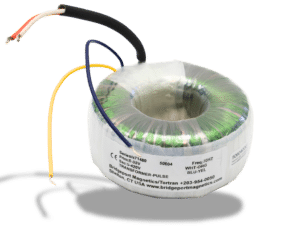
A toroidal core keeps the flux in a closed ring. The copper path is shorter than a stacked core. Less leakage. Less of the input becomes heat.
Dual MP6 runs in the high 90s. On this duty that is upwards of 98%. On 12 kVA, that gap is the difference between a locker that needs a blower and a locker that does not have one.
The laminated 50A boxes are large partly because they have to shed heat. This cabinet could not shed heat. The pucks did not ask it to. After the boat sat on shore power, the shelf space was warm, not a problem. That was the test the yard cared about once the door was shut.
Soft start, then isolation
The ELCI story had two halves.
Inrush. A 12 kVA core on a dead close looks like a fault to a 30 mA device for a moment. Soft start on each MP6 takes that edge off. The pedestal stayed closed on the first plug-in after the install. That had not been true the week before.
Leakage. Isolation removes the boat from the shore-ground path. The green shore conductor is capped. The boat side is its own system, neutral bonded per the diagram. The pedestal was no longer seeing the boat’s normal leakage as a dock fault.
Both had to be true. A 50A marine isolation transformer without soft start can still trip on the first close. Soft start without isolation does not stop corrosion.
Boost, because this boat moves
Home dock was not the only dock. East Coast yards, a run south, occasional Caribbean stops. Voltage is 240V at one finger and 208V at the next. Long docks sag.
Dual MP6 includes 104V and 208V taps. The yard landed the boat so boost is available when the pedestal is low, and straight 120/240V when it is not. It is a tap choice, not an automatic switching cabinet. For a boat that changes marinas, that is the useful version. They are not carrying a second transformer for 208V.
Charles Iso-Boost did the voltage job with an automatic board. That line is out of production, and it would not have fit this cabinet anyway.
What the landing had to get right
Dual MP6 is UL 1561 Recognized, UL Listed Marine (E509703), and ignition protected. It is designed for ABYC E-11 isolation-transformer practice when it is installed to the supplied diagrams, including the secondary neutral-to-ground bond.
On this boat the electrician:
- Treated the two pucks as one 12 kVA, 50A marine isolation transformer
- Landed primary and secondary per the Dual MP6 print
- Bonded the secondary neutral on the boat side
- Capped and insulated the shore green
- Closed every lead in the junction box
- Left the marina ELCI in place
The junction box is why the small cabinet stayed a small cabinet. Five feet of lead does not help if the splice is open in a wet bay.
What changed after
Zinc consumption went back to a normal season. The pedestal stopped opening on hookup. The marina had a 50A marine isolation transformer on the inlet, not an isolator. The owner did not give up a bunk or a lazarette to get it. Friday call. Monday ship. Installed in the space they already had.
That is the result a Dual MP6 installation is for. Not a catalog line. A cabinet that was empty, then was not, and a cord that stayed closed.
When this is the wrong puck
| Shore | Order |
|---|---|
| 30A, 120V | MP3.6 |
| Single 50A, 120V | One MP6, 6 kVA |
| 50A, 240V | Dual MP6, this install |
| 100A or two 50A cords | Two Dual MP6 systems |
This boat needed a 50A marine isolation transformer. Two pucks. Not four.
FAQ
What is a Dual MP6 installation?
Two MP6 isolation transformers used as one 12 kVA, 50A marine isolation transformer.
How fast did this one ship?
The call came Friday. The Dual MP6 shipped Monday.
Why did this boat stack them?
The only space was two shelves in a plywood cabinet. Each puck is 6.5 inches high. A single steel 50A box did not fit.
Does it need airflow?
This install added none. Efficiency in the high 90s, upwards of 98%, is why.
Will soft start stop every ELCI trip?
It removes magnetizing inrush. Isolation removes the shore-ground leakage path. A bad cord can still trip.
Can you skip boost?
Yes. Land the 104/208V taps for low docks. Leave them off on solid 240V.
Where is it made?
Shelton, Connecticut.
Product Callout
Bridgeport Magnetics MarinePuck Dual MP6
12 kVA, 50A marine isolation transformer. Two pucks, 12.6 in by 6.5 in, about 160 lb. Soft start and 104/208V boost included. Hermetically sealed flame-rated ABS. UL Listed Marine, ignition protected, made in the USA. This job: Friday call, Monday ship.
Phone: (203) 954-0050
Email: [email protected]
bridgeportmagnetics.com/product/marine-puck-dual-mp6-50a