By Dr. Aymen Lpizra, Vice President of Engineering, Bridgeport Magnetics Group
Every minute a customer spends without power counts against a utility’s reliability record. The System Average Interruption Duration Index (SAIDI) measures average outage minutes per customer per year, and major storms drive it up. The faster a utility restores service, the lower its SAIDI, and portable, easily deployed transformers are among the most practical tools for doing so.
Bridgeport Magnetics Group is a U.S.-based specialist in toroidal power transformers, building single-phase and three-phase units up to 350 kVA at up to 480 V. These units meet NEMA ST 20 for a 105 °C temperature rise and, where applicable, DOE 10 CFR 431.196 efficiency levels. This article explains why the toroidal core suits demanding applications, how its main challenge—inrush current—is controlled, and where these units add value.

Why the Toroidal Core
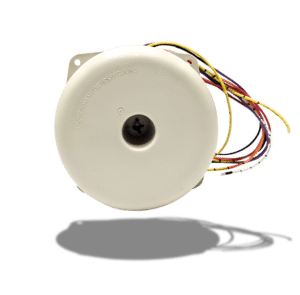
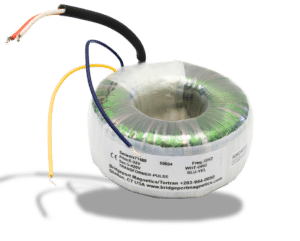
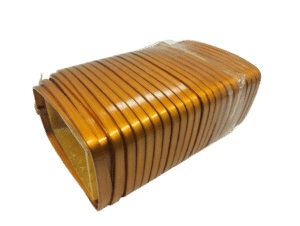
A toroidal transformer uses a ring-shaped core, typically continuous grain-oriented silicon steel tape wound on itself, with windings distributed around the full circumference. Because the magnetic path is a closed ring with no joints or air gaps, flux travels along the grain of the steel throughout. Compared with conventional laminated E-I designs, the results are:
- Higher efficiency. No gaps to magnetize and no cross-grain flux regions mean lower core loss and magnetizing current.
- Lower audible noise. No loose laminations or joints vibrate under magnetostriction.
- Low stray flux and tight coupling. Windings cover the whole core, so flux is contained and leakage inductance is low, giving good voltage regulation under changing load.
- Compact, light construction. A high flux density core delivers the same rating in a much smaller volume.
The Bridgeport Magnetics Product Range
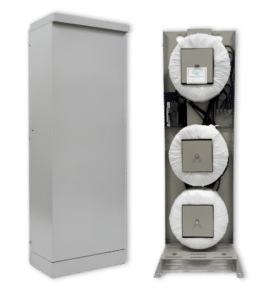
Bridgeport Magnetics Group builds first-class portable, high-efficiency power transformers for fast utility customer restoration and for distributed energy resource (DER) and battery storage applications. Single-phase and three-phase transformer sizes are up to 350 kVA at up to 480 V. NEMA ST 20 compliance at 105 °C gives specifiers a recognized thermal basis, and the units meet DOE 10 CFR 431.196 where applicable. Because design and manufacturing take place in the United States, custom voltages and windings can be delivered on short lead times. The company design offers a flexible orientation inside the enclosure, so units can be assembled vertically or horizontally to fit different applications and spaces, such as a narrow equipment room, a trailer, or a battery container.
Understanding and Controlling Inrush Current
A well-designed toroid offers better efficiency and less noise than a non-toroidal core, but it faces one major challenge: high inrush current caused by core saturation. Understanding it starts with the inductance of the core:
L = (N² × μm × Am) / Lm
where N is the number of winding turns, μm is the core material’s permeability, Am is the core cross-section, and Lm is the flux path length. In normal operation μm is high, so the magnetizing inductance is large and holds the magnetizing current to a very small value. If the material saturates, meaning no more magnetic dipoles remain to contribute to higher flux density, permeability falls to a value close to that of air. The inductance collapses with it, and so the magnetizing current increases.
The trigger is the way flux follows voltage. When a transformer is energized, core flux must follow the integral of the applied voltage (φ = ∫v dt). If switching occurs at a voltage zero crossing, flux must build from zero to twice the normal steady-state peak, because it starts at zero rather than at the negative peak. Any remanent flux from the last shutdown adds to this, so the required peak can reach two times rated flux density or more, plus the remanent flux Br.
That demand exceeds the core’s saturation flux density. Once saturated, the winding behaves like a small air-core inductor, limited only by winding resistance and leakage inductance, producing a brief spike of roughly 10 to 50 times rated current, sometimes more.
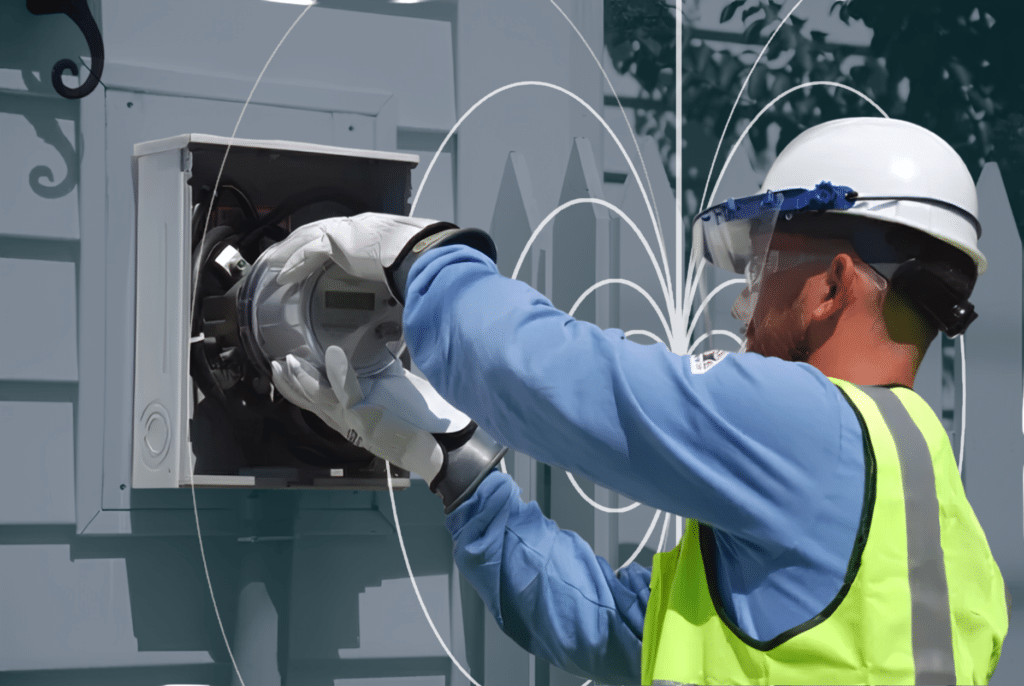
Bridgeport Magnetics Group addresses this at two levels. A special high-permeability core keeps magnetizing current very low in normal operation and minimizes core losses. A heat protection system and a soft-start system then prevent high inrush current. Soft-start limits the energization surge, while thermal protection safeguards the winding and core. Together they let the toroid’s efficiency be used without nuisance tripping of upstream protective devices, though protection settings should still be coordinated at the system level.
Utility Customer Restoration
When a storm damages the distribution system, restoration happens in stages. Crews first re-energize feeders and main lines, but individual customers can stay dark long after, because of damaged secondary line, a lost neutral, or a service that cannot be reconnected until a permanent repair is made. These tail-end outages count customer minutes just like large ones, and they are where a portable transformer is most valuable.
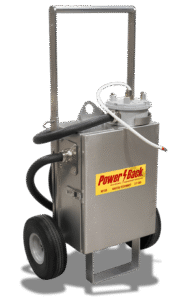
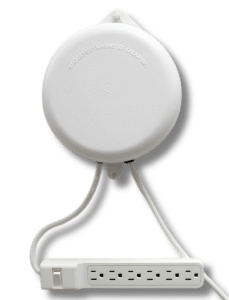
Bridgeport’s portable toroidal transformers are built for this task. Their high flux density core keeps weight and size low, so a crew can carry a unit to a customer site, connect it, and restore power without heavy lifting equipment. Typical uses include:
- Temporary replacement of a failed service transformer, restoring a home, small business, or commercial customer while a permanent unit is scheduled.
- Voltage conversion between the available supply and the customer’s service, for example from 480 V to the 208Y/120 V or 240/120 V the customer’s equipment requires.
- Isolation and restoration at the meter, bringing back lost phases or neutral conditions without a full line rebuild.
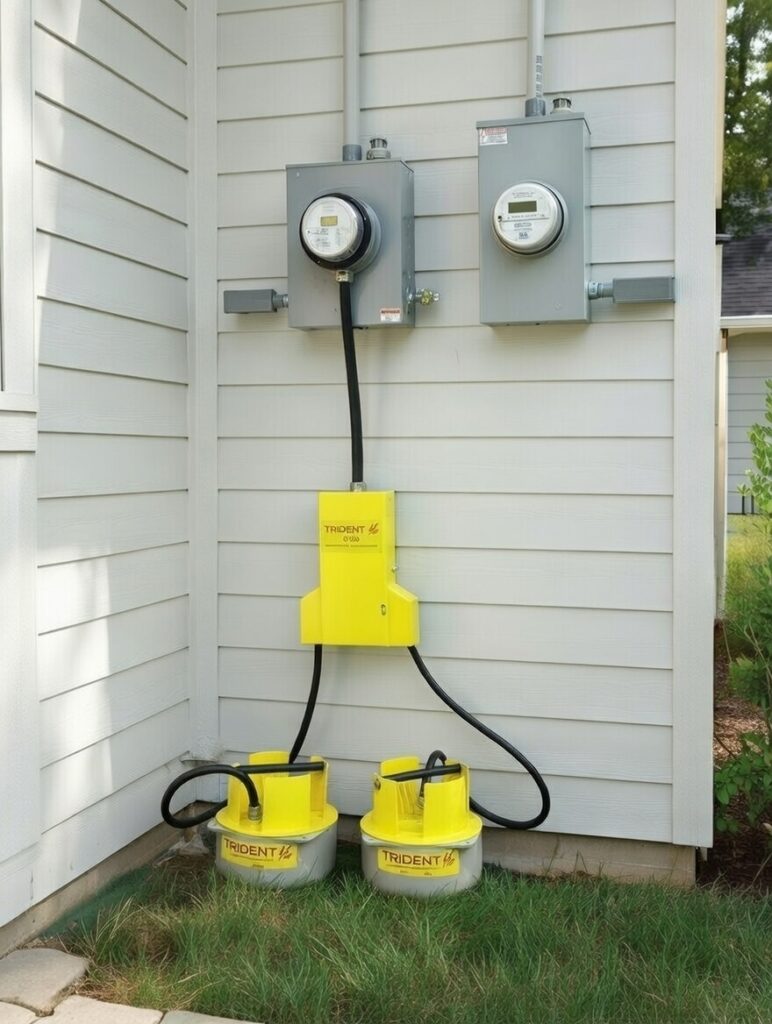
The benefit shows up directly in SAIDI: each customer restored hours or days earlier removes those minutes from the index. Because storms produce many simultaneous small outages, having many light, easily positioned units on hand lets a utility work in parallel rather than wait for the repair queue to clear. Their compact size also lets more fit on one truck, increasing the customers a crew can restore in a day.
Improving Reliability and Resiliency
Reliability is about how rarely and briefly power is interrupted; resiliency is about how well the system absorbs and recovers from severe events. Toroidal transformers contribute to both.
For reliability, the high-efficiency core runs cooler than a comparable laminated design because lower losses mean less heat. Lower operating temperature slows insulation aging, the NEMA ST 20 105 °C rating gives a verifiable thermal margin, and the built-in heat protection adds a safeguard against overload.
For resiliency, the key is flexibility. A pool of portable units gives a utility a standing restoration reserve that can be staged ahead of a forecast storm and deployed wherever damage occurs. Critical facilities such as water pumping stations, communication sites, shelters, and medical offices can be reconnected quickly while permanent repairs continue. Because the units are built in the United States, replenishing the reserve does not depend on long overseas lead times.
Green Energy Applications
Solar, wind, and battery storage connect to the distribution system through power electronics and transformers, and the transformer is a constant presence in the energy path. Several characteristics of the toroidal design match these needs.
- Efficiency where it matters. In battery storage, the transformer sits in the path of every charge and discharge cycle, so its losses reduce round-trip efficiency directly. In solar and wind, lower losses mean more generated energy reaches the grid.
- Compact design for limited space. Containerized batteries, rooftop inverter rooms, and small solar sites leave little room. A high flux density toroid has a small footprint, and its orientation options help it fit the layout.
- Low noise and low stray fields. DER installations often sit close to buildings and sensitive control electronics. Quiet operation and contained flux reduce neighbor complaints and interference.
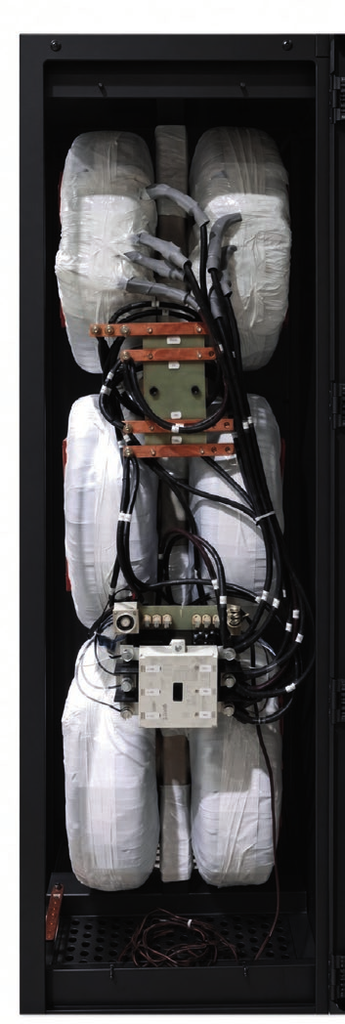
Bridgeport Magnetics high-efficiency three-phase toroidal transformer for BESS, solar, and distribution applications. Photo: Bridgeport Magnetics
Energization deserves particular care here. Storage and inverter systems are switched on and off many times, and each energization risks inrush. The soft-start system keeps the surge under control, so repeated starts do not stress the grid connection.
Temporary Installations for Construction Sites
Construction sites need power before permanent service exists, and requirements change as work progresses: small tools and site offices early, then cranes, welders, hoists, and temporary lighting. Equipment is often rated for a different voltage than the site supply, so a transformer must bridge them.
Portable toroidal transformers suit this environment well:
- Easy relocation. Light weight and compact size let the unit move as the work area shifts, without a crane or specialized rigging.
- Flexible placement. Vertical or horizontal mounting helps in tight spaces such as stairwells, trailers, shafts, or the corner of a work floor.
- Voltage conversion. From a 480 V supply, a unit can provide 208Y/120 V or other voltages for tools and equipment, in single-phase or three-phase up to 350 kVA.
- Lower running cost. A site transformer may run for many months; high efficiency reduces wasted energy over that period, and a cooler, quieter unit is easier to live with beside site offices and neighbors.
- Reuse. When the project ends, the same transformer can be redeployed to the next site or kept in reserve for emergencies.
Conclusion
The toroidal core combines high efficiency, low noise, low stray flux, and compact size. Its one significant weakness, inrush current from core saturation, is well understood: it arises when flux demand at energization exceeds the saturation limit and permeability collapses. Bridgeport Magnetics Group manages it through a special high-permeability core, a soft-start system, and a heat protection system.
With single-phase and three-phase units up to 350 kVA at up to 480 V, built in the United States to NEMA ST 20 and, where applicable, DOE 10 CFR 431.196, these transformers give utilities a fast way to restore customers after storms and improve SAIDI. They also meet the compactness and efficiency needs of solar, wind, and battery storage, and provide flexible, relocatable power for construction sites. Where speed, space, and efficiency are decisive, the toroidal transformer deserves a place in the specification.
About the Author
Dr. Mhd. Aymen Lpizra is Vice President of Engineering at Bridgeport Magnetics Group, where he sets the company’s technical direction and leads product design, R&D, application engineering, test, and compliance, including its move into higher-power products. He has more than 30 years of engineering and management experience, including nearly two decades in the electric utility industry. He previously served as T&D Standards Manager at Eversource Energy, leading transmission and distribution standards engineering across Connecticut, Massachusetts, and New Hampshire. He also held lead engineering roles in distribution and transmission planning at United Illuminating, with a focus on DER and BESS integration, generator interconnection, and system reliability. Earlier in his career, he was Director of Engineering at Diamond J, Inc., a company specializing in the design and manufacture of airplane engine monitoring instruments. Dr. Lpizra holds a Ph.D. in Electrical Engineering from Wichita State University and an M.S. in Measurement and Control from Idaho State University. He has taught graduate and undergraduate power systems courses at the University of Bridgeport and the University of New Haven. His publications include papers in Electric Power Systems Research and IEEE Xplore, as well as a co-authored paper for the CIGRE 2025 International Symposium on the design, implementation, and standardization of mobile battery energy storage in temporary power applications.
Bridgeport Magnetics Group
bridgeportmagnetics.com
(203) 954-0050