Winding Conductors
Magnet Wire
US-manufactured enameled copper winding wire - round and flat/rectangular - engineered for transformers, motors, and inductors. Bridgeport Magnetics has been winding magnet wire into precision magnetic components in Connecticut since 1982. Tell us your AWG size, insulation class, and temperature rating, and we'll quote wire built to your spec.

Fundamentals
What Is Magnet Wire?
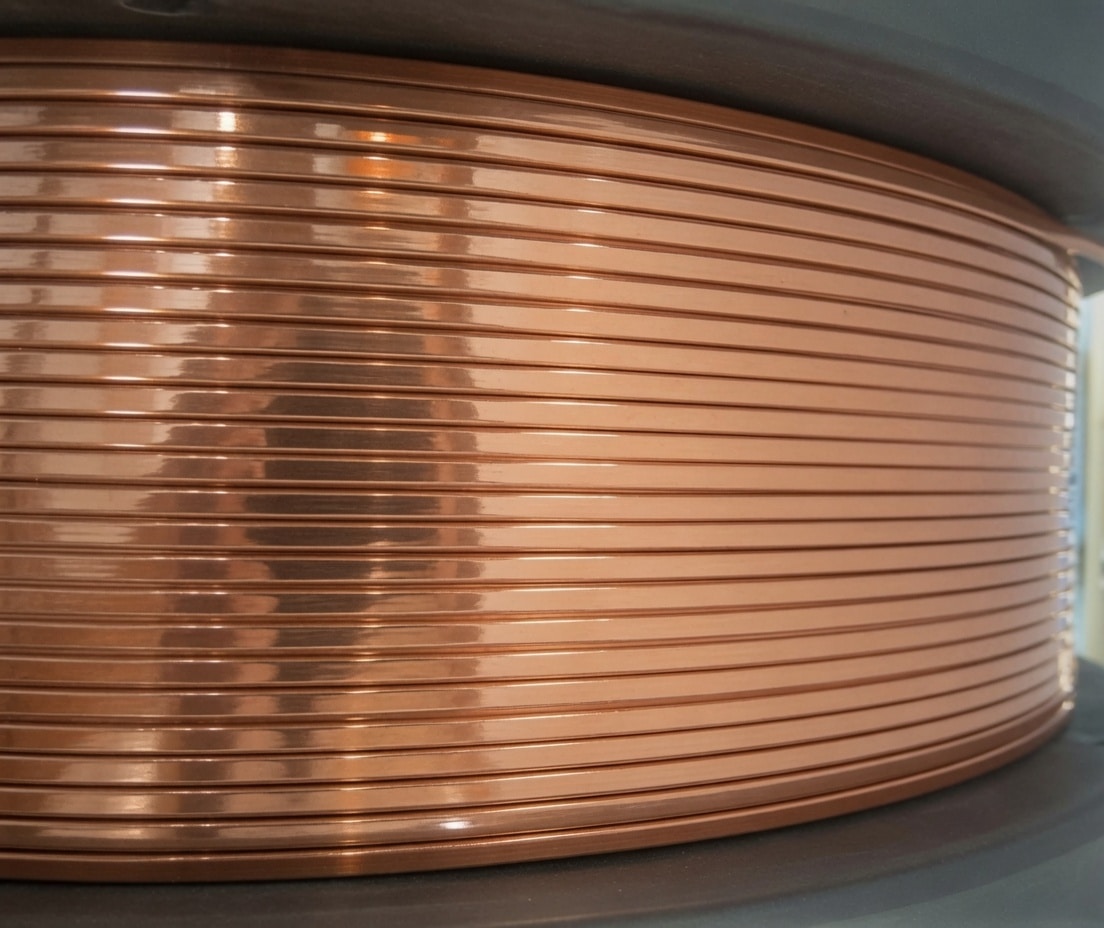
Magnet wire - also called enameled wire, magnetic wire, or winding wire - is a conductor, almost always copper, coated with a thin film of insulating enamel rather than a thick plastic jacket. That thin insulation is what makes it "magnet" wire: it lets thousands of turns pack tightly together in a coil so the winding produces a strong, controlled magnetic field in the smallest possible space.
Two variables define nearly every order: conductor size (AWG - smaller numbers mean thicker wire) and insulation build & temperature class (the enamel chemistry and film thickness that set how hot the wire can run and how much voltage it withstands between turns). Bridgeport supplies magnet wire to customers and as the working stock we wind into our own toroidal transformers - so the wire you buy is the wire we trust in our own builds.
Cross-Section
Round vs. Flat (Rectangular) Magnet Wire
The right choice depends on how much copper you need to fit into a given window and how much heat you need to move out of it.
Round Magnet Wire
The versatile standard - easy to wind, bends readily around tight radii, and suits the vast majority of transformer, motor, and inductor windings. Widest AWG range; best for high-turn-count, fine-gauge coils.
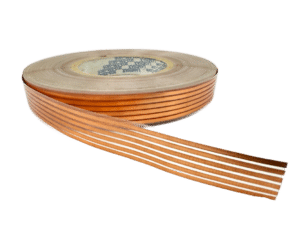
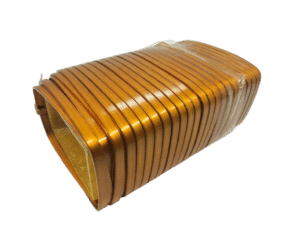
Flat / Rectangular Magnet Wire
A rectangular cross-section that packs more copper into the same window for higher power density and better heat dissipation. Bridgeport introduced flat wire in 2001; available in standard thickness-to-width ratios of 1:2, 1:2.5, 1:3, 1:3.5, and 1:4.
See flat magnet wire sizes →Insulation
Insulation Types & Temperature Classes
The enamel coating is a precision engineering choice. Magnet wire insulation is standardized under NEMA MW 1000 (and IEC 60317), which defines each enamel chemistry, its film build, and its rated thermal class - the maximum continuous conductor temperature at which the insulation retains its rated life (commonly Class 155, 180, 200, or 220 °C).
Sizing
Magnet Wire Sizes & AWG Gauge Guide
Magnet wire is specified by AWG. The larger the AWG number, the thinner the wire — each three-step change roughly halves the cross-sectional area. Enamel insulation adds to the finished overall diameter depending on build and temperature class. Bridgeport supplies round wire across the fine-to-heavy range and flat wire from 32 AWG up to 11 AWG.
Applications
What Magnet Wire Is Used For
Transformers
The winding conductor in power, isolation, and toroidal transformers — tight, uniform layering directly controls efficiency, regulation, and thermal performance.
Toroidal transformers →Motors & Generators
Specialty and high-efficiency motors depend on tightly packed windings; flat wire raises fill factor and heat dissipation in compact, high-current stators and rotors.
Inductors, Chokes & Coils
Inductors, solenoids, chokes, and electromagnets rely on controlled turns of insulated copper; gauge and insulation class set inductance, current rating, and temperature rise.
Inductors & chokes →Why Bridgeport
Why Buy Magnet Wire from Bridgeport Magnetics
US manufacturer since 1982
Operating from Shelton, Connecticut — domestic supply, domestic support, no overseas lead-time roulette.
We wind what we sell
Magnet wire is the working stock in our own toroidal transformer production — we know how it behaves under real winding tension and thermal load.
Round and flat under one roof
From fine-gauge round wire to flat wire in five standard ratios, plus specialty wire for demanding builds.
Built to your spec
Tell us AWG, insulation class, temperature rating, and reel format — we quote wire to match, not the closest thing in stock.
Engineering support included
Not sure of the gauge or insulation class? Our engineers help you select it.
FAQ
Magnet Wire — Frequently Asked Questions
Almost always copper, coated with a thin film of insulating enamel (such as polyurethane, polyester-imide, or polyamide-imide). The thin enamel lets thousands of turns pack tightly into a coil.
Yes. "Magnet wire," "enameled wire," "enameled copper wire," "magnetic wire," and "winding wire" all refer to the same product — insulated copper conductor used to wind coils. The name varies by industry and region.
Gauge is driven by the current you need to carry, the number of turns, and your allowable temperature rise and resistance. Larger AWG numbers are thinner wire. Share your electrical requirements and our engineers will recommend a gauge.
It's the maximum continuous conductor temperature the insulation is rated for while retaining its service life — commonly Class 155, 180, 200, or 220 °C. Higher classes use tougher enamel chemistries.
Round wire is the versatile standard and winds easily. Flat/rectangular wire packs more copper into the same space for higher power density and better heat dissipation — ideal for compact, high-current windings. See our flat magnet wire page for sizes.
Yes. We supply magnet wire to customers as well as using it in our own transformer production. Request a quote with your AWG size, insulation class, and quantity.
From 32 AWG up to 11 AWG in standard thickness-to-width ratios of 1:2, 1:2.5, 1:3, 1:3.5, and 1:4. For ratios thinner than 1:4, ask about our Laminax products.
Request a Magnet Wire Quote
When your build demands magnet wire spec'd to exact dimensions and temperature performance, work with a US manufacturer that winds it every day. Send us your AWG size, insulation class, temperature rating, and quantity.