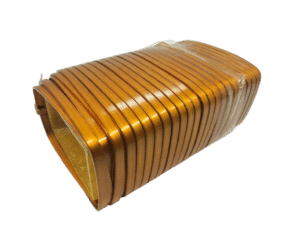
Designing a custom transformer helps give you exactly what you need: voltage, VA rating, and frequency. However, custom toroidal transformer designs have more going on: core materials, winding configurations, leakage current requirements, and UL listings.
If you’re new to designing a custom toroidal transformer, Bridgeport Magnetics can help. We walk you through design parameters, material choices, and specific details that are often overlooked. This helps ensure the transformer performs as expected and doesn’t become the weak link in your power supply.
Find out the key design questions you need answered before you begin your custom transformer. And when you need a consultation, we are here to help.
About Us
Bridgeport Magnetics has been designing and manufacturing custom toroidal transformers in Shelton, CT since 1982. The engineering considerations outlined here come from four decades of building transformers from 30VA to 50,000VA for applications across marine, medical, industrial, utility, and audio markets.
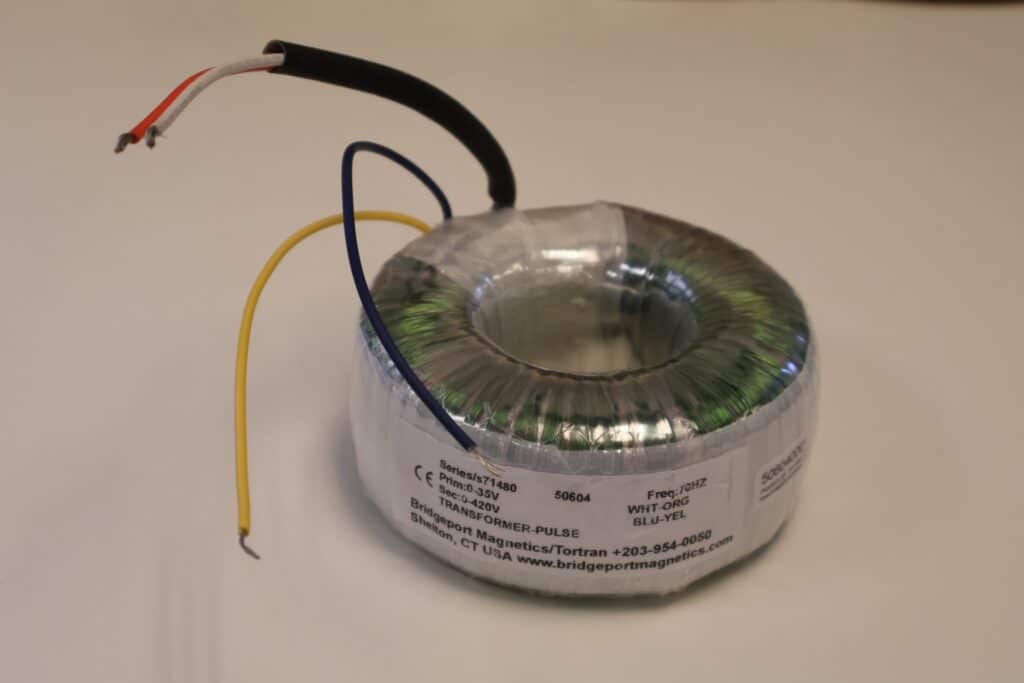
Why Toroidal: The Engineering Case for a Donut-Shaped Core
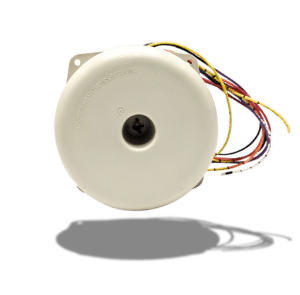
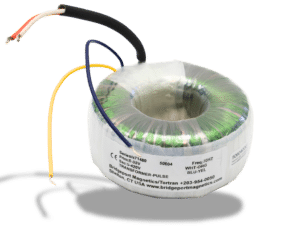
Do you know why toroidal geometry has become the preferred choice for a growing number of applications? It’s because a toroidal transformer uses a donut-shaped core, typically wound from grain-oriented silicon steel (GOSS) or amorphous metal strip.
The primary and secondary windings are distributed evenly around the entire circumference of the core. This creates a nearly ideal magnetic circuit with several advantages over traditional E-I laminated designs.
Size and Weight. Toroidal transformers are 40-50% lighter and smaller than E-I transformers of the same VA rating. For a 5kVA unit, that can mean the difference between a 60-pound transformer and a 30-pound one. In applications where enclosure space is limited, like marine engine rooms, medical equipment housings, or rack-mounted systems, the reduction matters.
Efficiency. The continuous grain orientation of the toroidal core minimizes magnetic flux leakage and reduces core losses. Typical efficiency runs between 90% and 95%, depending on the design. Lower no-load losses also mean less wasted energy when the transformer is energized but not under full load.
Electromagnetic Interference. Because the windings cover the entire core surface, the magnetic field is largely self-contained. Toroidal transformers generate significantly less stray electromagnetic field compared to E-I designs. For systems with sensitive electronics nearby, this can be a key advantage for safety and efficiency.
Audible Noise. E-I transformers are notorious for the 60Hz hum caused by magnetostriction in loosely stacked laminations. Toroidal cores, wound from a single continuous strip, produce far less audible noise. In recording studios, medical environments, and residential applications, quiet operation is often a requirement that the toroidal design can meet.
Design Details for a Custom Toroidal Transformer
When you work with a toroidal transformer manufacturer to build a custom design, it’s helpful to have a base understanding of the key design details. The more you can specify what you need upfront, the faster and more accurate the quoting process. At Bridgeport Magnetics, we consult on your design and your needs to ensure the final product works for you.
Voltage and Turns Ratio
You will need to define your primary input voltage and your required secondary output voltage(s). If your application requires tight voltage regulation under varying load conditions, specify the acceptable regulation range. Standard toroidal designs typically provide 5-10% regulation from no-load to full-load.
Common configurations include:
- Single primary, single secondary (e.g., 120V to 24V)
- Single primary, multiple secondaries (e.g., 120V to 24V + 12V + 5V)
- Dual primary for 120/240V input flexibility
- Center-tapped secondaries for full-wave rectification
VA Rating and Duty Cycle
The volt-ampere (VA) rating determines the physical size of the transformer. At Bridgeport Magnetics, we build custom toroidal transformers from 30VA to 50,000VA. That range covers everything from a small signal transformer for a laboratory instrument to a high-power industrial unit for motor drive applications.
When determining your VA rating, consider:
- Continuous vs. intermittent duty: A transformer running 24/7 at full load needs a different thermal design than one that cycles on and off.
- Inrush current: Toroidal transformers can have high inrush current at startup due to their excellent magnetic coupling. If your circuit uses a breaker or fuse, specify the inrush tolerance so the designer can incorporate soft-start provisions or gap the core appropriately.
- Ambient temperature: A transformer rated for 5kVA at 25C ambient will derate at 50C. Specify your operating environment.
Frequency
Most North American applications run at 60Hz, but if your design is for export (50Hz markets), aviation (400Hz), or a variable-frequency application, the frequency directly affects core sizing and losses. A transformer designed for 60Hz will saturate if operated at 50Hz without derating. Always specify the operating frequency.
Isolation and Safety Requirements
For applications in medical, marine, and industrial environments, isolation between primary and secondary is critical. Key specifications include:
- Dielectric withstand voltage: The voltage the insulation must survive without breakdown (typically 2,500V to 4,000V for standard applications, higher for medical isolation transformers).
- Leakage current: Medical applications under IEC/UL 60601-1 require leakage current below 500 microamps under normal conditions. Specify your leakage budget.
- Electrostatic shield: A Faraday shield between primary and secondary windings reduces capacitive coupling and common-mode noise. This is standard for medical and audio applications and optional for general-purpose designs.
Physical Constraints
Toroidal transformers mount differently than E-I designs. Standard mounting uses a single center bolt through the core hole. If the transformer must fit inside an existing enclosure, provide a drawing. A few millimeters of clearance can change the core and winding design entirely.
Your physical constraint outline should include:
- Maximum outer diameter
- Maximum height
- Mounting orientation (horizontal, vertical, or either)
- Lead length and termination style (flying leads, terminal block, connector)

Core Materials: GOSS vs. Amorphous vs. Nanocrystalline
The core material affects the design of the custom toroidal the most after confirming your electrical specifications. It’s important to know your options, pros, and cons to determine what you will want for your design.
Grain-Oriented Silicon Steel (GOSS) is the primary material for toroidal transformer cores. It offers a strong balance of magnetic permeability, saturation flux density, and cost. For most power transformer applications between 50Hz and 400Hz, GOSS is the standard choice.
Amorphous Metal Alloys offer significantly lower core losses than GOSS, often 70-80% lower at equivalent flux density. The tradeoff is higher material cost and lower saturation flux density, which means a physically larger core for the same VA rating. Amorphous cores excel in applications where the transformer operates at partial load for extended periods, such as utility distribution transformers or always-on industrial systems.
Nanocrystalline Alloys combine high permeability with low losses across a wide frequency range. They are the material of choice for high-frequency applications (above 1kHz) and precision current sensing transformers.
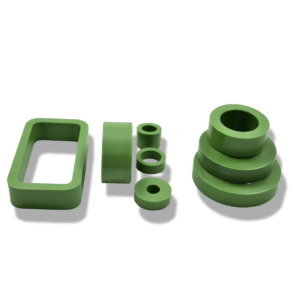
For most custom toroidal transformer projects in the 60Hz power range, GOSS delivers the best value. Bridgeport Magnetics manufactures its own strip-wound toroidal cores through its Alpha-Core brand, giving full control over core quality, dimensional tolerances, and material traceability.
Winding Configuration and Insulation
The winding design determines the transformer’s regulation, leakage inductance, thermal performance, and safety characteristics.
Winding distribution on a toroidal core should be as uniform as possible around the full circumference. Uniform distribution minimizes leakage inductance and ensures even thermal loading across the winding. Bridgeport’s winding machines maintain consistent tension and lay patterns for reliable, repeatable performance.
Insulation class determines the maximum operating temperature. Common classes for toroidal transformers include:
| Class | Max Temperature | Typical Application |
|---|---|---|
| A | 105C | General purpose, low-cost |
| B | 130C | Industrial, moderate environments |
| F | 155C | High-reliability, elevated ambient |
| H | 180C | Harsh environments, military, industrial |
Specifying a higher insulation class adds cost but provides margin for thermal excursions and extends service life. For enclosed applications with limited airflow, Class F or H is often worth the investment.
Vacuum impregnation with varnish or epoxy encapsulates the windings, reducing moisture ingress, improving dielectric strength, and damping vibration. It is standard on higher-VA units and recommended for any transformer operating in demanding environments such as marine vessels or outdoor utility installations.
Certifications: UL, CSA, EN, IEC
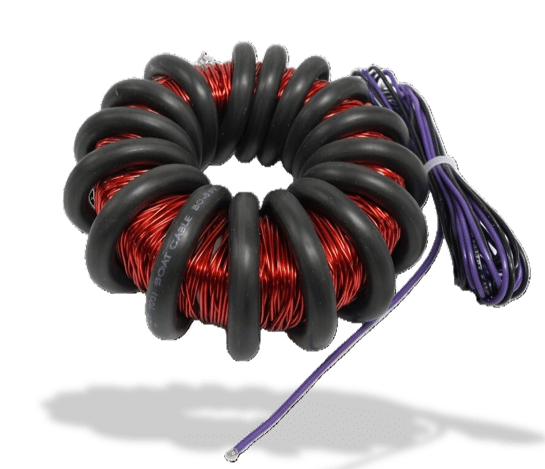
Certifications are not optional for many applications. They are a fundamental part of the design specification. This is why we design and manufacture transformers to meet UL, CSA, EN, and IEC standards. If your product requires specific certification marks, state this in your initial specification request. Designing for certification from the start avoids costly redesigns later.
- UL (Underwriters Laboratories) recognition is required for most commercial and industrial products sold in the United States.
- CSA (Canadian Standards Association) is required for products sold in Canada.
- EN (European Norm) and IEC (International Electrotechnical Commission) standards apply to products sold in European and international markets.
- Medical applications require compliance with UL/IEC 60601-1, which imposes additional requirements for leakage current, dielectric strength, and creepage/clearance distances.
Common Custom Toroidal Transformer Applications
- Marine shore power isolation: Protecting boats and yachts from galvanic corrosion and shore power faults. See our marine isolation transformers.
- Medical device power supplies: Meeting 60601-1 leakage requirements for patient-contact equipment.
- Industrial motor drives: High-power toroidal transformers for variable-frequency drive input isolation.
- Audio and AV systems: Low-noise toroidal designs for recording studios, broadcast equipment, and high-end amplifiers.
- Utility metering: Precision current transformers for revenue-grade energy measurement.
- Renewable energy: Isolation transformers for solar inverters, battery storage systems, and EV charging stations.
How to Request a Custom Toroidal Transformer Quote
When contacting Bridgeport Magnetics, or any other custom toroidal transformer manufacturer, you want to include as much information as you can about the foundational design and the application needs. If a specification document is available, always attach this in your initial quote request. However, we are able to work with engineers who have only a rough idea of what they need.
Bridgeport Magnetics engineers work with customers at every stage of the design process, from initial concept through prototype and production. All design and manufacturing takes place in our 45,000 sq ft facility in Shelton, Connecticut. Typical design turnaround for custom quotes is 24-48 hours.
Please Include:
- Primary voltage and frequency
- Secondary voltage(s) and current(s)
- VA rating
- Operating environment (indoor/outdoor, ambient temperature range)
- Any certification requirements (UL, CSA, IEC 60601, etc.)
- Physical size constraints (if applicable)
Ready to get started? Request a quote or call our engineering team at (203) 954-0050.
Frequently Asked Questions
What is a custom toroidal transformer?
A custom toroidal transformer is a transformer built to specific electrical and mechanical requirements rather than selected from a standard catalog. Custom parameters include voltage, VA rating, insulation class, certifications, and physical dimensions. Custom designs are often preferred to ensure the proper usage, certifications, safety precautions, and more.
How much does a custom toroidal transformer cost?
The cost of a custom toroidal transformer depends on the VA rating, core material, winding complexity, insulation class, and certification requirements. Small custom toroidal transformers (under 500VA) typically cost less than standard off-the-shelf alternatives when ordered in moderate quantities, because the design is optimized for your exact requirements. Contact Bridgeport Magnetics with your specifications for an accurate quote.
What is the lead time for a custom toroidal transformer?
Prototype lead times are typically 2-4 weeks from design approval. Production lead times depend on volume and complexity but generally range from 4-8 weeks for standard orders. Bridgeport Magnetics manufactures all products in Shelton, CT, which eliminates the import shipping delays associated with overseas sourcing.
What sizes of toroidal transformers can Bridgeport Magnetics manufacture?
Bridgeport Magnetics designs and manufactures custom toroidal transformers from 30VA to 50,000VA (50kVA). This range covers everything from small signal transformers to high-power industrial units. Both single-phase and three-phase configurations are available.
Are toroidal transformers better than E-I transformers?
Toroidal transformers offer measurable advantages over E-I designs in most applications: 40-50% smaller and lighter, higher efficiency (90-95%), significantly lower electromagnetic interference, and quieter operation. E-I transformers may still be preferred for very high power ratings (above 50kVA) or applications where cost is the primary constraint.