A streetlight transformer isolates the lighting circuit from the primary supply so a degraded cable, wet splice, or weak neutral does not put voltage on metal the public touches. Streetlights sit on sidewalks, in parks, and along roads where people and pets make contact every day. When a pole or nearby object becomes energized, the result can range from a tingle to a serious shock. Utilities use isolation transformers as one practical way to separate that circuit and limit the exposure.
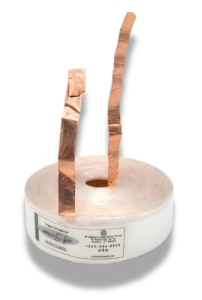
Bridgeport Magnetics has built toroidal transformers in Shelton, Connecticut since 1982. The company supplies compact, weatherproof streetlight transformers for poles, bases, and handholes where space is limited and the unit must run unattended for years.
The Shock Nobody Sees
A metallic streetlight pole looks harmless until a person or pet touches it and feels a shock. Pets often notice first. Complaints follow. The voltage can come from several places. A damaged cable insulation, a corroded splice, or moisture that creates a path from a live conductor to the pole structure can energize metal that was never meant to carry current. A weakened neutral return can also raise the voltage between the pole and the ground a person stands on.
The Electric Power Research Institute has studied stray and contact voltage for more than 20 years. It identifies four basic sources:
- Faults that do not self-clear, such as damaged insulation in service boxes, light poles, or moisture paths
- Voltage drop along current-carrying neutral conductors, known as neutral-to-earth voltage
- Magnetic induction from electrical current flow
- Electric induction onto metal poles and other objects
Streetlight circuits are especially exposed to the first two. Aging cable, degraded splices, water ingress, and a weakened neutral all contribute. One documented case traced an energized object to a degraded split-bolt splice wrapped with improperly applied PVC tape. A small defect produced a real consequence.
Why It Matters to Utilities and Cities
Contact voltage on streetlight poles creates three levels of concern:
| Level | What Happens | Typical Outcome |
|---|---|---|
| Aversion | People or animals feel a sensation and avoid the location | Complaints, reduced use of the area |
| Injury | A startle reaction causes a fall or spill | Medical claims, liability |
| Fatality | Heart fibrillation or respiratory paralysis | Rare but severe, major public and legal impact |
Published shock thresholds range from 15 V in some standards to 30 V and 50 V in others. Sidewalks, fences, and hydrants are public places. An energized pole brings liability, repair cost, and loss of public trust. Cities and utilities face both the immediate safety issue and the longer-term cost of repeated complaints and inspections.
Diagnose Before You Mitigate
No single document covers every case. Good practice is to measure at the complaint location, analyze the waveform, and trend the voltage over time before choosing a fix. A clean 60 Hz sine wave points to a faulted phase conductor. Distortion and harmonic content, such as a strong third harmonic, point to a neutral or return-path problem. Analysis of waveform and phase angle can identify the source about 90 percent of the time. That result decides whether isolation is the right tool or whether the neutral itself needs remediation.
| Waveform Observation | Likely Source | Isolation Transformer Role |
|---|---|---|
| Clean 60 Hz sine wave | Faulted phase conductor | Separates the lighting circuit from the fault path |
| Distorted with strong third harmonic | Neutral or return-path problem | Prevents the supply neutral voltage from appearing on the pole circuit |
| Mixed or intermittent | Combination of issues | Provides circuit separation while other repairs are planned |
Where a Streetlight Transformer Fits
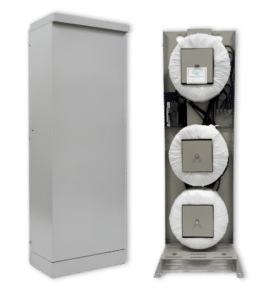
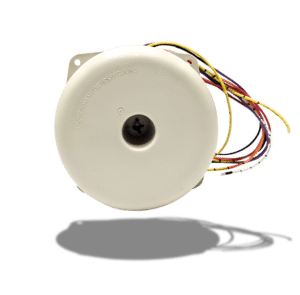
Bridgeport Magnetics streetlight transformers use toroidal cores potted in rugged, weatherproof enclosures. They are compact, efficient, and built for decades of unattended outdoor service. That suits poles, bases, and handholes where space is tight and access is limited after installation.
An isolation transformer gives the lighting circuit galvanic isolation. The secondary has no direct conductive connection to the primary supply. That helps with:
- Neutral-to-earth voltage and return-path problems: the isolated secondary does not carry the supply neutral’s voltage onto the pole’s circuit
- Shock exposure: it limits voltage between the fixture and its surroundings
- Circuit separation: it keeps the lighting circuit apart from a noisy or degraded neutral path
Isolation is listed as a core mitigation option alongside neutral remediation such as resized or parallel neutrals, more pole grounds, and lower substation ground resistance. In some documented cases, double-insulated isolation transformers have been used as a customer-side fix where the source was difficult to eliminate completely.
Built in the USA for Utility Procurement
- Made in Shelton, Connecticut, with U.S.-based design, production, and quality control
- Intertek (ETL) certified and UL recognized; certification documents and test reports are available on request for procurement packages
- Custom toroidal designs from 30 VA to 70 kVA, so engineers can specify ratings, dimensions, and shielding for a given circuit
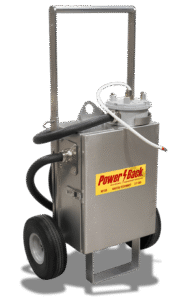
The same facility also builds temporary power restoration units, precision metering current transformers, and compact auxiliary and control power transformers for substations. Utilities can work with one U.S. manufacturer across several needs.
Why Toroidal Construction Matters for Streetlight Circuits
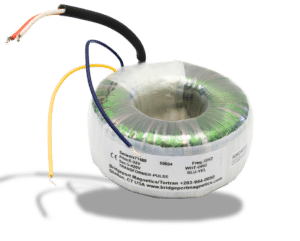
A toroidal core has no joints or air gaps. Flux travels along the grain of the steel throughout the closed ring. The result is lower core loss, lower audible noise, and tighter coupling than a traditional laminated design. For a streetlight transformer that may sit in a pole base for years, those characteristics reduce heat, reduce the chance of nuisance complaints from hum, and keep the unit small enough to fit where a larger laminated transformer would not.
The potted construction seals the windings and core against moisture. Streetlight circuits live outdoors. Water ingress is one of the original causes of the problem the transformer is meant to mitigate. A sealed unit reduces the chance that the mitigation device itself becomes another failure point.
Practical Considerations for Installation
A streetlight transformer is typically installed in the pole base, in a handhole, or in a nearby enclosure. The primary connects to the existing lighting circuit. The secondary feeds the fixture. The secondary neutral is bonded once on the load side according to the utility’s grounding practice. The primary and secondary are galvanically separate.
Because the unit is compact, it often fits in the same space as the original splice or small control transformer. Lead lengths and mounting orientation can be specified so the unit lands without major rework of the pole base. Once installed, the transformer runs continuously. High efficiency and low heat mean the unit does not require special ventilation in a closed base.
FAQ
What is a streetlight transformer used for?
A streetlight transformer isolates the lighting circuit from the primary supply. It reduces the chance that a fault or neutral problem on the supply side will energize the pole or fixture that the public touches.
Does every streetlight need an isolation transformer?
No. Isolation is one mitigation tool. It is most useful when measurements show that the voltage on the pole comes from the supply neutral or from a fault that is difficult to eliminate immediately. Other cases may be solved by repairing the cable, improving the neutral, or adding grounds.
How does a streetlight transformer differ from a regular transformer?
A regular transformer may share a neutral or have limited isolation. An isolation transformer provides galvanic separation between primary and secondary. The secondary circuit is electrically independent of the primary supply neutral and ground reference.
Can a streetlight transformer be installed in an existing pole base?
Yes. The compact toroidal design is sized for poles, bases, and handholes. Custom lead lengths and mounting options allow it to fit existing spaces.
Are Bridgeport Magnetics streetlight transformers certified?
Yes. They are Intertek (ETL) certified and UL recognized. Documentation is available for utility procurement packages.
What size streetlight transformer do I need?
Ratings are available from 30 VA up to 70 kVA. Most streetlight circuits use smaller units matched to the lamp or fixture load. An engineer can specify the exact rating, voltage, and shielding for the circuit.
Take the Next Step
Do not wait for a complaint or an incident. Start with a contact voltage survey, diagnose the source, and isolate the lighting circuit where it makes sense. To discuss your streetlight network, call (203) 954-0050 or talk to an engineer.
Bridgeport Magnetics Group
Shelton, Connecticut
bridgeportmagnetics.com
[email protected]