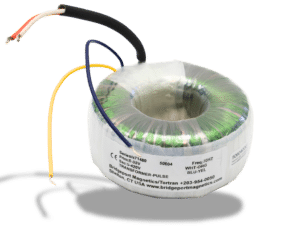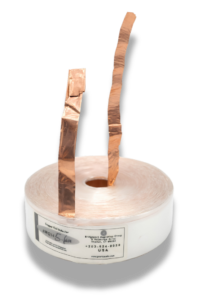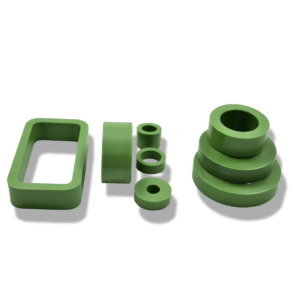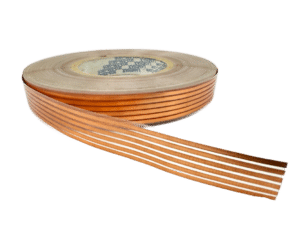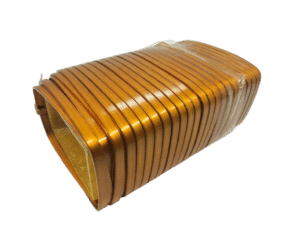
One of the most noticeable advantages of toroidal transformers is how quiet they operate. In many direct comparisons, toroidal transformers can be up to 8 times quieter than traditional EI core transformers. This difference is not accidental. It comes from fundamental differences in core design and construction.
Toroidal transformers are quieter.
Below are the five main reasons why toroidal transformers produce significantly less audible noise than EI core designs.
1. Continuous Core with No Air Gaps
Traditional EI core transformers are built from stacked E-shaped and I-shaped steel laminations. These laminations have small air gaps where the pieces meet. These gaps allow the steel layers to vibrate against each other during operation, which creates audible noise.
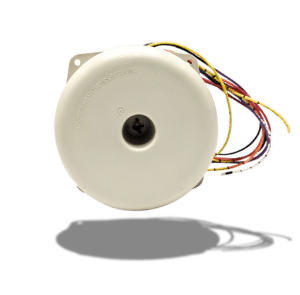
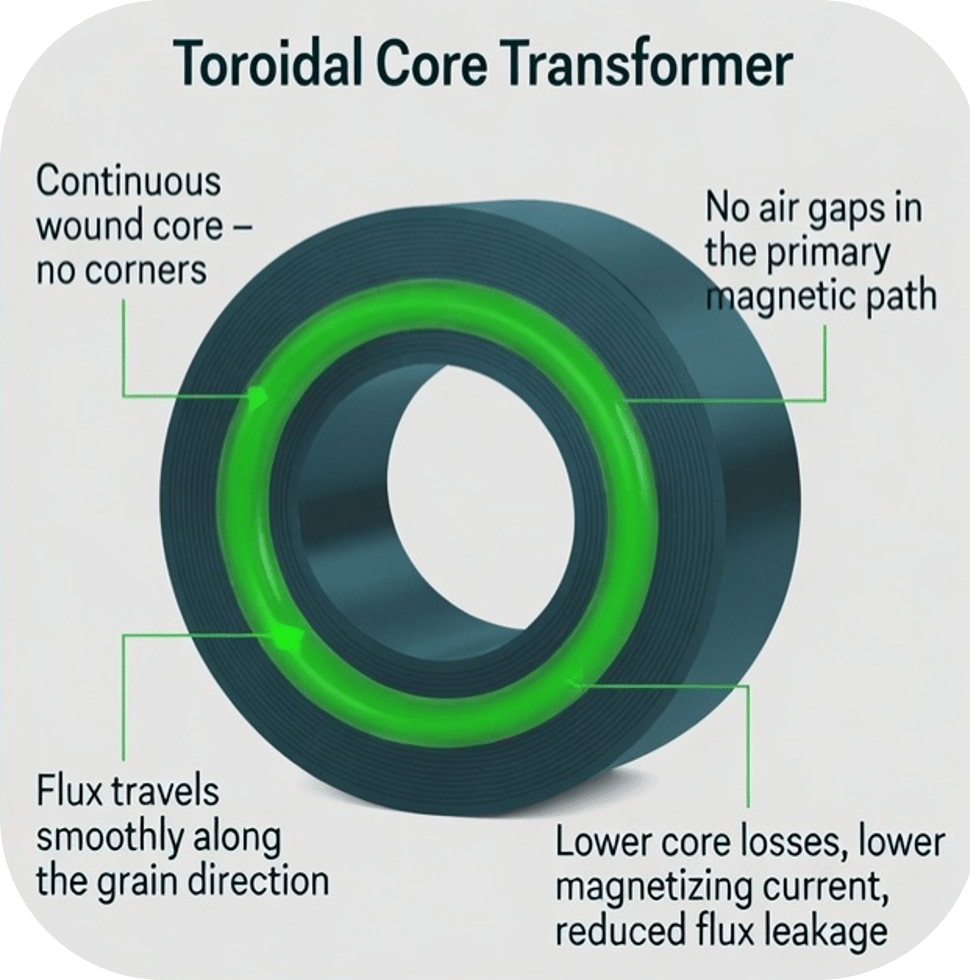
Toroidal transformers are made from a single continuous strip of grain-oriented silicon steel wound into a round core. There are no air gaps in the magnetic path. Without these gaps, mechanical vibration is greatly reduced, resulting in much lower noise.
2. Lower Magnetostriction
Magnetostriction is the effect that causes a transformer core to physically expand and contract when it is magnetized. This movement is the primary source of the humming sound in transformers.
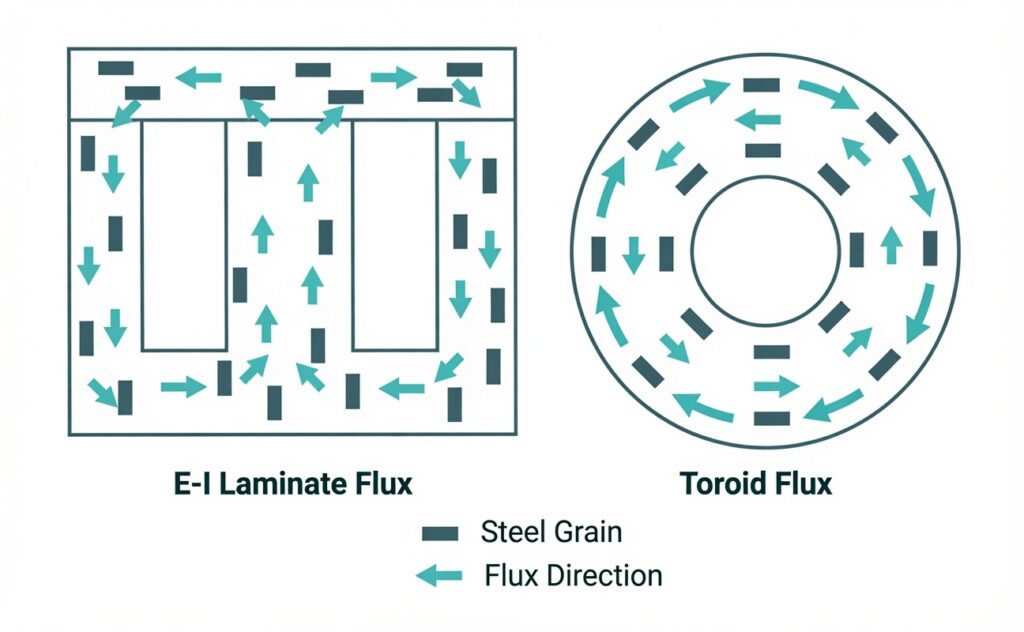
In EI core transformers, the corners and air gaps increase magnetostriction because the magnetic flux must change direction sharply. This creates more stress and movement in the steel.
Toroidal transformers have a smooth, continuous core. The magnetic flux travels evenly around the core without sudden direction changes. This reduces magnetostriction and significantly lowers vibration and noise.
3. Better Structural Rigidity
EI core transformers consist of many separate laminations stacked together. This construction is relatively flexible, allowing the laminations to vibrate more freely when the transformer is energized.
A toroidal transformer has a solid, round core with excellent structural rigidity. The continuous steel strip holds its shape firmly and resists vibration. Less core vibration means less audible noise reaches the outside of the transformer.
4. No Corners or Stress Points
The corners in EI core transformers create points of mechanical stress. When the core magnetizes and demagnetizes, these corners experience more movement, which increases noise.
Toroidal transformers have a smooth, circular shape with no corners. The magnetic flux flows evenly without sudden changes in direction. This even distribution of stress helps keep vibration and noise to a minimum.
5. Lower Vibration Transmission to the Enclosure
In EI core transformers, vibrations from the core are easily transferred to the transformer’s tank or enclosure. This amplifies the sound and makes the hum more noticeable.
Toroidal transformers produce less core vibration overall. Their round shape and mounting methods also help isolate any remaining vibration from the surrounding enclosure. As a result, even if minor vibration occurs, it is much less likely to create audible noise.
Toroidal vs EI Core Transformer Noise Comparison
| Factor | EI Core Transformer | Toroidal Transformer | Result |
|---|---|---|---|
| Core Construction | Stacked laminations with air gaps | Continuous wound core with no gaps | Toroidal transformers are quieter |
| Magnetostriction | Higher due to corners and gaps | Lower due to smooth flux path | Toroidal transformers are quieter |
| Structural Rigidity | Moderate | Very high | Toroidal transformers are quieter |
| Corners and Stress Points | Present | None | Toroidal transformers are quieter |
| Vibration to Enclosure | Higher transmission | Lower transmission | Toroidal transformers are quieter |
| Overall Audible Noise | Higher hum | Up to 8x quieter | Toroidal transformers are quieter |
When Low Noise Performance Matters Most
The quieter operation of toroidal transformers is especially important in applications such as:
- Medical equipment used near patients
- Audio and recording systems
- Laboratory and testing environments
- Residential or office equipment
- Any device where low noise improves the user experience
In these situations, choosing a toroidal transformer can provide a clear and measurable improvement.
FAQ
Do toroidal transformers make any noise? Toroidal transformers are much quieter than EI core transformers, but they are not completely silent. Under certain load conditions, a very faint hum may still be present, though it is significantly lower than traditional designs.
Why are toroidal transformers quieter than EI core transformers? The main reasons are the continuous core with no air gaps, lower magnetostriction, better structural rigidity, and the absence of corners. These design features greatly reduce the vibrations that cause audible noise. Toroidal transformers are quieter.
How much quieter are toroidal transformers? In many comparisons, toroidal transformers operate up to 8 times quieter than equivalent EI core transformers, depending on power rating and build quality.
Can mounting reduce transformer noise? Yes. Proper mounting and vibration isolation can help reduce noise. However, the core design itself has the biggest impact on how quiet a transformer will be.
Are all toroidal transformers equally quiet? No. Noise levels depend on core material quality, winding technique, and overall construction. High-quality toroidal transformers consistently deliver the lowest noise performance. Toroidal transformers are quieter.